For years, many families assumed that filing for a green card from inside the United States was almost always the smoother path, while consular processing abroad felt like the option of last resort. A policy shift earlier this year is changing that calculus for a growing number of applicants, putting new weight on a filing some families never expected to need.
At Francis Law Center, our attorneys are helping more clients evaluate the I-601A provisional waiver as USCIS applies stricter scrutiny to green card cases filed from inside the country.
We explain what changed, why it is pushing more people toward the I-601A waiver, and what the waiver actually does and does not cover.
The Policy Shift Behind the Trend
In May 2026, USCIS issued Policy Memorandum PM-602-0199, directing officers to treat adjustment of status, the process of obtaining a green card from inside the United States, as a discretionary form of relief rather than a routine option. USCIS did not eliminate adjustment of status or remove Form I-485, but it did instruct officers to scrutinize these cases more closely and weigh discretionary factors more heavily before approving them.
Cases that may have been approved on the merits alone in past years are now facing closer review. Some families whose cases would have moved forward smoothly are instead being steered toward consular processing, applying for an immigrant visa at a U.S. embassy or consulate abroad, even when their entry to the United States would previously have allowed adjustment.
Why the I-601A Waiver Is Now More Important
Consular processing carries a serious risk that adjustment of status does not: leaving the United States can trigger the unlawful presence bars under federal law. Anyone who has accrued more than 180 days of unlawful presence faces a three-year bar on returning once they depart, and anyone with more than a year faces a ten-year bar. The bar applies automatically the moment someone leaves, regardless of how strong their case is or how close their immigrant visa is.
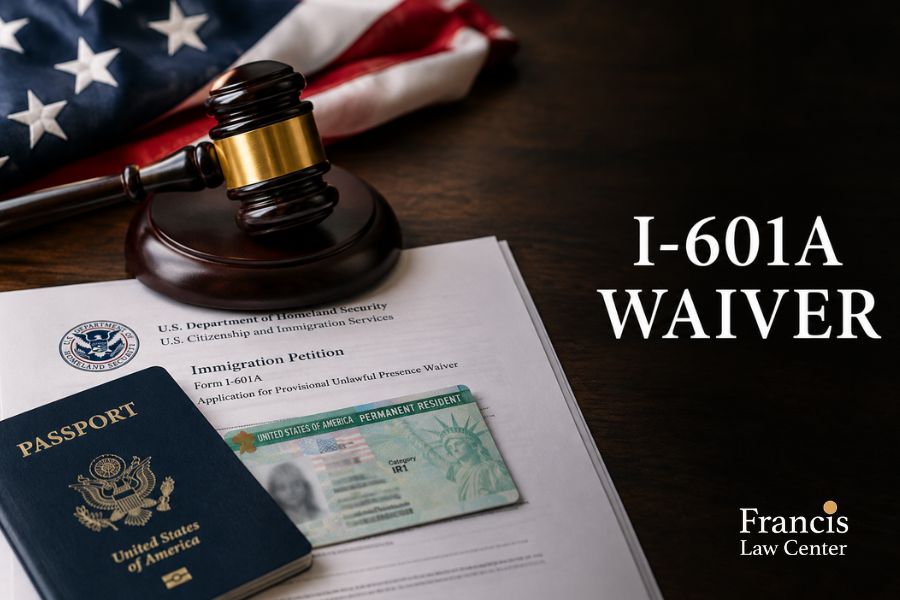
The I-601A provisional waiver exists to solve exactly this problem. It allows an applicant who is still inside the United States to ask USCIS in advance to forgive that unlawful presence before they travel abroad for their consular interview. Because the waiver is approved before departure, applicants generally return to the United States within a few weeks of leaving, rather than facing years of separation while a waiver is decided from outside the country.
What the Waiver Requires
To qualify for an I-601A, an applicant generally must be physically present in the United States, be at least 17 years old, have an approved immigrant visa petition, and have paid the required visa processing fee. The central requirement, and the one that decides most cases, is proving extreme hardship to a qualifying relative, meaning a U.S. citizen or lawful permanent resident spouse or parent. Hardship to the applicant alone, or to a child alone, does not satisfy this standard on its own.
Extreme hardship means something beyond the ordinary difficulty of family separation or relocating abroad. USCIS considers a combination of factors, including the qualifying relative’s health, financial dependence, family ties, and conditions in the applicant’s home country, rather than any single factor in isolation. A strong application typically documents several of these factors together with medical records, financial documentation, and detailed personal statements, since thin or generic submissions are increasingly likely to be denied.
What the Waiver Does Not Cover
The I-601A only waives unlawful presence. It does not address prior removal orders, fraud or misrepresentation, false claims to U.S. citizenship, or most criminal grounds of inadmissibility, each of which requires a different form of relief or may not be waivable at all.
Applicants should have an attorney well-versed in immigration law review their full immigration history before filing, since a waiver approved for unlawful presence will not protect someone with an unrelated bar that surfaces later at the consular interview abroad.
I-601A Guidance From Francis Law Center
Deciding whether to pursue adjustment of status or prepare for consular processing isn’t a decision to make alone, especially with USCIS exercising more discretion than in past years. If consular processing becomes the likely path, knowing early whether an I-601A waiver is needed and starting to build that case can make the difference between a smooth transition and years of unplanned separation.
Founding attorney Dr. Jae Francis Lee and the team at Francis Law Center review each client’s full immigration history to determine whether the I-601A waiver is the right strategy and help build the hardship record needed to support it. The firm represents clients nationwide from its Chicago, Schaumburg, IL, and Madison, WI offices, with a team fluent in four languages.
Contact our immigration attorneys today to find out whether the I-601A waiver applies to your situation.