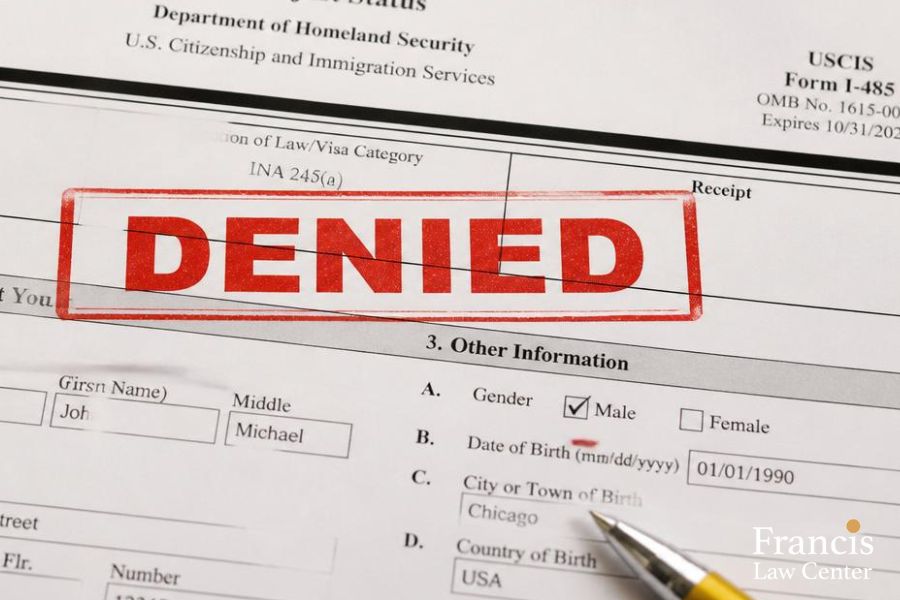
On May 21, 2026, U.S. Citizenship and Immigration Services issued Policy Memorandum PM-602-0199, fundamentally reshaping how officers decide adjustment of status applications filed from inside the United States. If you have a pending Form I-485 — or you were planning to file one — this new USCIS adjustment of status policy changes the strategy on your case immediately.
The press release framing suggested applicants must now leave the country and complete consular processing abroad. That framing is misleading. The real change is quieter, more legally significant, and far more dangerous for the unprepared: USCIS now treats adjustment of status as an “extraordinary form of relief,” giving officers broader discretion to deny applications — and once denied, applicants without lawful status can be placed directly into removal proceedings.
Here is what every Green Card applicant inside the U.S. needs to understand about the new memo, who is most at risk, who is still protected, and what to do next.
What USCIS Policy Memorandum PM-602-0199 Actually Says
PM-602-0199 does not change the underlying immigration statute. INA § 245 still governs adjustment of status. Eligibility requirements remain the same. What changes is the discretionary standard officers apply when reviewing applications.
The memo formally reclassifies adjustment of status as an “extraordinary discretionary relief” rather than a routine administrative process. It directs USCIS officers to consider the long-standing case law — particularly Matter of Blas, 15 I&N Dec. 626 (BIA 1974) — establishing that applicants must demonstrate “unusual or outstanding equities” to receive favorable discretion.
The memo’s authority is grounded in INA § 245(a) and § 103(a)(3), and it builds on Supreme Court precedent in Patel v. Garland, 596 U.S. 328 (2022), which held that adjustment of status is a matter of grace, not entitlement.
The Operative New Standard: “Unusual or Outstanding Equities”
The most important practical change in the memo is the standard officers will now apply. Under Matter of Blas, an applicant cannot simply have a clean record. The memo states explicitly: “The absence of adverse factors, by itself, does not demonstrate such unusual or outstanding equities.”
This means USCIS officers can now deny adjustment of status applications even when the applicant meets every statutory requirement, if the applicant cannot affirmatively prove that exceptional positive equities outweigh any contravention of immigration norms. Adverse factors specifically called out include:
- Failure to depart when a nonimmigrant period expired
- Unauthorized employment
- Status violations after admission
- Fraud or false testimony in any government interaction
- Conduct inconsistent with the original purpose of the visa or parole
For a comprehensive view of USCIS adjudication standards, see the USCIS Policy Manual, Volume 7, Part A, which the new memo directly references.
What the Press Release Got Wrong
USCIS’s accompanying press release implied that nonimmigrants must now consular process from their home country. The memo’s text does not impose that requirement. INA § 245 still allows eligible applicants to file from inside the U.S. — the memo simply makes discretionary denial more likely.
The distinction matters. This is not a “you must leave” rule. It is a “you can be denied, and if denied you can be placed in removal proceedings” rule. That practical reality drives the urgency of getting your case reviewed by an experienced immigration attorney now.
Who Is Most at Risk Under the New USCIS Adjustment of Status Policy
The memo will affect every pending I-485, but certain applicant profiles face dramatically elevated denial risk.
Visitor Visa, Student Visa, and Overstay Filers
If you entered on a B-1 or B-2 visitor visa or an F-1 student visa and later filed for adjustment of status — particularly if you overstayed — your case sits at the highest risk under the new memo. The memo specifically identifies “failure to depart as expected” and “intention to reside permanently in the United States” when consular processing was available as adverse discretionary factors.
Parolees and Those Who “Failed to Depart”
Applicants paroled into the United States under INA § 212(d)(5)(A) — including humanitarian parolees — face heightened scrutiny under the memo’s framing that parolees are “expected to depart” when their parole purpose has been served. Cases involving Uniting for Ukraine, Cuban/Haitian/Nicaraguan/Venezuelan (CHNV) parole, or other humanitarian parole programs warrant immediate strategic review.
Who Still Has Stronger Protections
Not every adjustment of status case is equally exposed. Several categories retain meaningful statutory protections that the memo expressly preserves.
Immediate Relatives of U.S. Citizens
Spouses, parents, and unmarried children under 21 of U.S. citizens are statutorily carved out from many of the INA § 245(c) bars. Marriage-based Green Card applicants retain the strongest statutory footing — but discretion still applies, which means the standard for approval is higher than it was before May 21, 2026.
VAWA, Asylum, T, U, and Crime-Victim Cases
VAWA self-petitioners are explicitly excepted from § 245(c) bars in the statute itself. Asylees adjusting under INA § 209(a) and certain other category-specific adjusters benefit from non-discretionary statutory frameworks the memo cannot override. T and U visa holders adjusting under § 245(l) and § 245(m) likewise retain category-specific protections.
Dual-Intent Visas (H-1B and L-1)
The memo expressly acknowledges that “applying for adjustment of status is not inconsistent with simultaneously maintaining nonimmigrant status in a category with dual intent.” H-1B specialty occupation workers and L-1 intracompany transferees can continue to file I-485 applications while maintaining their underlying nonimmigrant status. However, the memo also warns that “maintaining lawful status in a dual intent nonimmigrant category is not sufficient, on its own, to warrant a favorable exercise of discretion.”
Translation: dual intent protects you from one specific adverse factor, but it does not exempt you from the discretionary analysis. H-1B and L-1 adjusters still need to build affirmative equities into the record.
Non-Discretionary Categories: § 209, NACARA, HRIFA, and More
Several adjustment of status pathways are statutorily non-discretionary, meaning USCIS must approve them if the eligibility requirements are met. These include:
- INA § 209(a)(2) asylee adjustments
- NACARA (Nicaraguan Adjustment and Central American Relief Act)
- HRIFA (Haitian Refugee Immigration Fairness Act)
- The Cuban Adjustment Act
- Liberian Refugee Immigration Fairness
- NDAA § 7611 for certain Afghan special immigrants
If you adjust under one of these provisions, the new “unusual or outstanding equities” standard does not apply to your case. Confirming which statutory basis applies to your adjustment is itself now a critical part of your case consultation with immigration attorneys.
The Real Danger: The Denial-to-Removal Pipeline
Here is the consequence the press release did not name. Under the still-active 2018 USCIS Notice to Appear memorandum, USCIS routinely issues Notices to Appear (NTAs) when an applicant is denied a benefit and has no other lawful status to fall back on. A discretionary denial of an I-485 under PM-602-0199, combined with the 2018 NTA framework, materially increases the likelihood that a denied applicant will be placed in removal proceedings before the immigration court.
This is the practical risk every adjustment applicant should understand. The headline is not “you must consular process.” The headline is “you can be denied — and if you are, you may face deportation court next.”
For applicants worried about this trajectory, having a strategy in place before filing is no longer optional. More than ever, working with an experienced immigration attorney who handles family-based visas, humanitarian visas, and removal defense cases is essential to navigate this challenging and ever-changing immigration process.
Why Strategy Matters More Than Ever
Every adjustment application now needs three things that were previously optional:
- A clear affirmative equities narrative
- A documented response to any adverse factors in the record
- A contingency strategy if the application is denied
This is not paperwork. It is case theory. And it is now the difference between approval and removal proceedings.
How to Protect Your I-485 Case Under the New Standard
If you have a pending application, or you are preparing to file, the next steps are the same: get your case reviewed by an experienced immigration attorney, build the strongest possible discretionary record, and prepare for every realistic outcome.
Build Affirmative Equities Into the Record
Officers cannot exercise discretion in your favor based on facts that are not in the file. Documentation of family ties, U.S. citizen children, long-standing residence, employment history, community involvement, tax compliance, and any humanitarian considerations should be assembled into a coherent equities package — not buried in an appendix.
Address Adverse Factors Head-On
If your case has any adverse factor — overstay, prior status violation, unauthorized employment, or anything else the officer will see — the worst strategy is silence. The new memo rewards applicants who acknowledge adverse factors and provide context, mitigation, and offsetting equities. Hoping the officer does not notice is no longer viable strategy.
Consider Consular Processing as a Strategic Option (Not a Mandate)
For some applicants, especially those with limited equities and high adverse-factor exposure, consular processing through the U.S. Department of State may now be a more predictable path than adjustment of status. The memo does not require consular processing, but in certain cases it removes the deportation-court risk that a discretionary AOS denial creates.
This is a strategic decision, not a default one. Whether consular processing is right depends on inadmissibility analysis, waiver eligibility, country conditions, and personal circumstances.
Practical Next Steps for Pending and Future I-485 Filers
If you fall into any of the categories below, you should schedule a case review as soon as possible:
- You have a pending I-485 that has not yet been adjudicated
- You are about to file an I-485 (especially marriage-based)
- You are on H-1B or L-1 and considering adjustment
- You entered on a B-1, B-2, F-1, or J-1 visa and have a pending Green Card path
- You were paroled into the U.S. and were planning to adjust
- You have any adverse factor — overstay, prior denial, unauthorized employment — and an underlying immigrant petition
The new standard rewards preparation. The denial pipeline punishes those who file without one.
How Francis Law Center Can Help
At Francis Law Center, immigration law is all we do. Our experienced legal team is dedicated to helping individuals and families across the United States understand their rights and options under U.S. immigration law. Whether you need help with applying for asylum, exploring relief from deportation, or navigating any other complex immigration matter, we are here to guide you every step of the way.
Hablamos español. Our Spanish-speaking team is available to assist clients who feel more comfortable communicating in Spanish. We believe language should never be a barrier when it comes to protecting your future.
For more updates, legal tips, and immigration resources, we invite you to explore our website or connect with us for a personalized consultation. We serve clients in all 50 states and are ready to help you move forward with confidence.
Contact Francis Law Center today to speak with an attorney and find the best path forward for your situation. Call 877-430-4201 or schedule your consultation online.