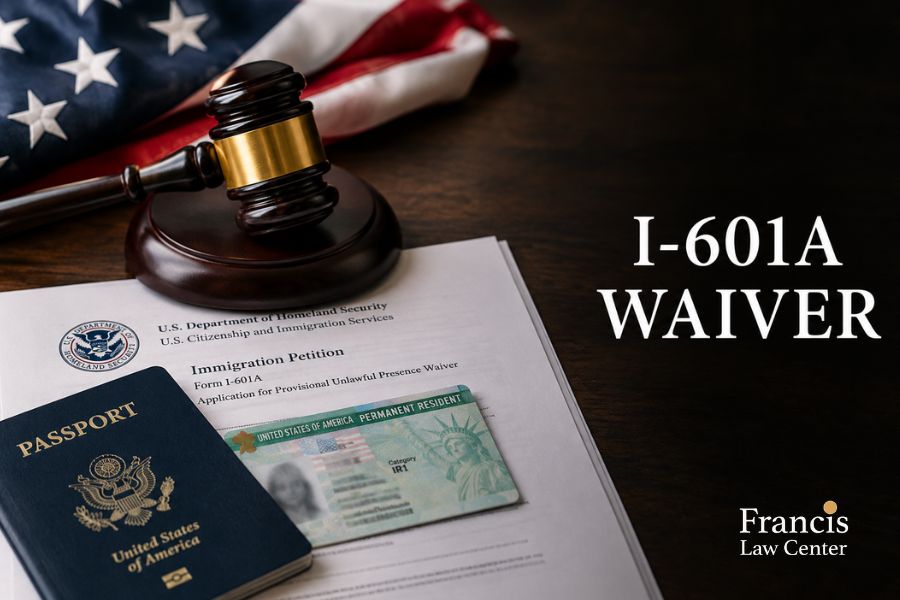

They say nobody gets approved under the current administration. In July 2026, our client – an elderly father who first crossed the border in 1998 – walked into the United States consulate in Ciudad Juárez for his immigrant visa interview. His I-601A waiver, formally known as the provisional unlawful presence waiver, had already been approved by USCIS after a notario nearly destroyed his case. One day after the interview, his immigrant visa was approved. After almost three decades of living in the United States without status, he is coming home as a lawful permanent resident, with his Green Card on the way.
The popular story right now is that everything is frozen – that consulates deny everyone and families should simply wait for a different political climate. The truth is more precise. Scrutiny is up and the margin for error has nearly disappeared, but well-prepared cases are still being approved – including at Ciudad Juárez, a consulate known for some of the toughest questioning in the consular system. What has changed is not whether approvals happen; it is who gets them: applicants whose forms, evidence, and testimony are ready before anyone sits down in the interview chair.
In this article, you will learn what the I-601A provisional waiver actually does and who qualifies for it, why the Ciudad Juárez immigrant visa interview carries such high stakes for Mexican nationals, and how disciplined preparation – accurate forms, organized documents, and mock interviews – changes outcomes.
What the I-601A Provisional Waiver Actually Does
Many people who qualify for a family-based immigrant visa cannot finish the process inside the United States. Because they entered without inspection, adjustment of status is generally not available to them, no matter how strong the family relationship is. Their only path to a Green Card runs through consular processing – attending an immigrant visa interview at a United States consulate abroad. For decades, that requirement hid a trap, and the Form I-601A, Application for Provisional Unlawful Presence Waiver exists to solve it.
The 3- and 10-Year Unlawful Presence Bars
Under section 212(a)(9)(B) of the Immigration and Nationality Act, a person who accrues more than 180 days of unlawful presence in the United States and then departs is barred from returning for three years. A person who accrues one year or more of unlawful presence and departs is barred for ten years. Notice the trigger: the bar attaches upon departure. That is the trap – the process requires leaving the country, and leaving is exactly what activates the bar. Without a waiver, an applicant could attend his interview in Ciudad Juárez and find himself locked out of the United States for a decade.
Extreme Hardship to a Qualifying Relative
The I-601A waiver forgives the unlawful presence bars before they take effect, but it is not automatic. The applicant must prove that refusing his admission would cause extreme hardship to a qualifying relative – and the law defines that term narrowly. A qualifying relative is a United States citizen or lawful permanent resident spouse or parent of the applicant. Hardship to the petitioning son or daughter, however real, is not the legal test. USCIS evaluates extreme hardship under the factors described in Volume 9 of the USCIS Policy Manual – medical needs, financial dependence, caregiving obligations, country conditions, and their cumulative weight. Building this showing is evidence work, not storytelling: records, letters, evaluations, and documentation assembled into a coherent legal argument.
Why “Provisional” Matters: Approval Before You Leave
The word “provisional” is the heart of the strategy. The I-601A is filed and decided while the applicant is still in the United States. The family knows the waiver is approved before anyone buys a plane ticket. That certainty transformed consular processing for mixed-status families. But the waiver has limits: it forgives only unlawful presence. It does not forgive fraud, criminal grounds, or prior removal orders, and if a different ground of inadmissibility surfaces at the consulate, the provisional approval does not cover it. That is why an honest, complete review of the applicant’s entire history at the very start of the case is the foundation everything else stands on.
One Father’s Case: Almost 30 Years Without Status
Our client crossed the border in 1998. For almost three decades he lived and worked in the United States without status, raising a family, staying out of trouble, and watching his children grow into United States citizens. Cases like his are common. What made his outcome uncommon was what happened after things went wrong.
The Notario Problem: When Bad Help Makes Things Worse
In much of Latin America, a “notario” is a highly trained legal professional. In the United States, a notario is not an attorney and is not authorized to give legal advice – and USCIS specifically warns immigrants against relying on them. Our client learned this the hard way: a notario took his family-based case and botched it, leaving a damaged record an attorney would later have to untangle. Notario errors are not just wasted money – wrong forms and careless statements become part of a permanent government record, and in the worst cases they can push a person into removal proceedings (deportation court) instead of toward a Green Card. When Francis Law Center took over, the first job was not filing something new. It was understanding everything that had already been filed.
The IR5 Path: A US Citizen Son Petitions for His Father
The engine of this case was simple and powerful: our client’s United States citizen son, over the age of 21, petitioned for his father. That is the IR5 category – an immediate-relative immigrant visa for the parent of an adult United States citizen. Immediate-relative visas are not subject to annual numerical limits, so there is no years-long visa queue. But a petition only establishes the family relationship. It does not erase inadmissibility. For a father with almost 30 years of unlawful presence, the IR5 petition and the I-601A waiver had to work together – the petition opening the door, the waiver making it safe to walk through.
Winning the Request for Evidence (RFE)
USCIS did not simply approve the waiver. It issued a Request for Evidence – an RFE – a formal notice that the evidence submitted is not yet enough to decide the case, with a deadline to fix it. An RFE is not a denial; it is a second chance, governed by the evidence standards in the USCIS Policy Manual. Respond weakly or late, though, and the case fails. We treated the RFE as an opportunity to rebuild the record, answering exactly what the officer asked. The waiver was approved.
Why Ciudad Juárez Is Known for Tough Scrutiny
Every immigrant visa for a Mexican national runs through the United States consulate at Ciudad Juárez, one of the busiest immigrant visa posts in the world. Questioning is detailed: dates of entry, periods of unlawful presence, identity documents, prior filings, and the consistency of all of it against the government’s own records. Under the current administration, vetting has only intensified. For an applicant with decades without status and a paper trail damaged by a notario, this is the hardest room in the process.
What Happens at the Immigrant Visa Interview
By interview day, the applicant has completed consular processing steps through the National Visa Center, finished the required medical examination, and submitted the DS-260 immigrant visa application. The officer compares live testimony against that entire record. Inconsistencies – even innocent ones – produce refusals, requests for more documents, and months of delay. Our client, prepared for exactly this, answered clearly and consistently. His immigrant visa was approved the very next day.
The Real Lesson: Preparation Beats Fear
Nothing about this outcome was luck. Before the interview, our client completed three preparation sessions and a full mock interview with our team. Every question he faced in Ciudad Juárez was a question he had already practiced answering – truthfully, calmly, and consistently with his record. Every case is different, and no attorney can promise an approval; anyone who guarantees an outcome is telling you something the law does not allow them to know. What preparation does is remove the avoidable reasons for refusal, so the case is decided on its real merits. More than ever, working with an experienced immigration attorney who handles family-based visas, humanitarian visas, and removal defense cases is essential to navigate this challenging and ever-changing immigration process.
Why Strategy Matters More Than Ever
In a tighter enforcement climate, small mistakes that once got waved through now become refusals. Sequencing matters: petition first, waiver approved before departure, interview only when the record is ready. Consistency matters: a DS-260 that contradicts an old entry date, or a hardship claim that does not match the medical records, invites exactly the scrutiny that sinks cases. Strategy is not a luxury in 2026 – it is the difference between a next-day approval and a decade of separation.
How to Prepare for a Consular Interview That Counts
Get the DS-260 Right
The DS-260 is a sworn application, and every answer becomes part of the permanent record the officer tests at the window. Addresses, entries and exits, employment history, family information – each must be accurate and consistent with every prior filing, including anything a notario filed years earlier. Reviewing that history before submission is where many cases are quietly saved.
Build a Document File That Answers Questions Before They Are Asked
An organized document file – identity records, the approved petition and waiver notices, relationship evidence, financial support documents – lets the applicant respond to any request at the window instead of leaving with a refusal slip and a checklist. Officers notice preparation. Disorganization reads as risk.
Practice Under Pressure: The Mock Interview
A consular interview is a high-stress conversation with life-changing stakes, often conducted in minutes. Mock interviews turn the unknown into the familiar. Our client’s three preparation sessions covered his timeline, his documents, and the difficult questions his history invited – so on interview day, nothing surprised him. Calm, truthful, consistent answers are trained, not hoped for.
Practical Next Steps for Families Considering the I-601A Path
This path deserves a serious look if any of the following describes your family:
- You entered the United States without inspection, and a United States citizen spouse, parent, or adult son or daughter can petition for you
- You have a United States citizen or lawful permanent resident spouse or parent who would suffer extreme hardship if you could not return
- A notario or unlicensed consultant handled your immigration paperwork and you are not certain what was filed
- You have an approved family petition but have been afraid to leave for the consular interview
Every case is different, and the right first step is not a form – it is a full review of your immigration history. Begin with a case consultation with immigration attorneys who can examine everything already in your record, identify every ground of inadmissibility, and map the sequence before anything is filed.
How Francis Law Center Can Help
At Francis Law Center, immigration law is all we do. Our experienced legal team is dedicated to helping individuals and families across the United States understand their rights and options under U.S. immigration law. Whether you need help with applying for asylum, exploring relief from deportation, or navigating any other complex immigration matter, we are here to guide you every step of the way.
Hablamos español. Our Spanish-speaking team is available to assist clients who feel more comfortable communicating in Spanish. We believe language should never be a barrier when it comes to protecting your future.
For more updates, legal tips, and immigration resources, we invite you to explore our website or connect with us for a personalized consultation. We serve clients in all 50 states and are ready to help you move forward with confidence.
Contact Francis Law Center today to speak with an attorney and find the best path forward for your situation. Call 877-430-4201 or schedule your consultation online.